Borehole Pumps, Water Filtration, Water Pumps, Water Storage, Water Storage Tanks
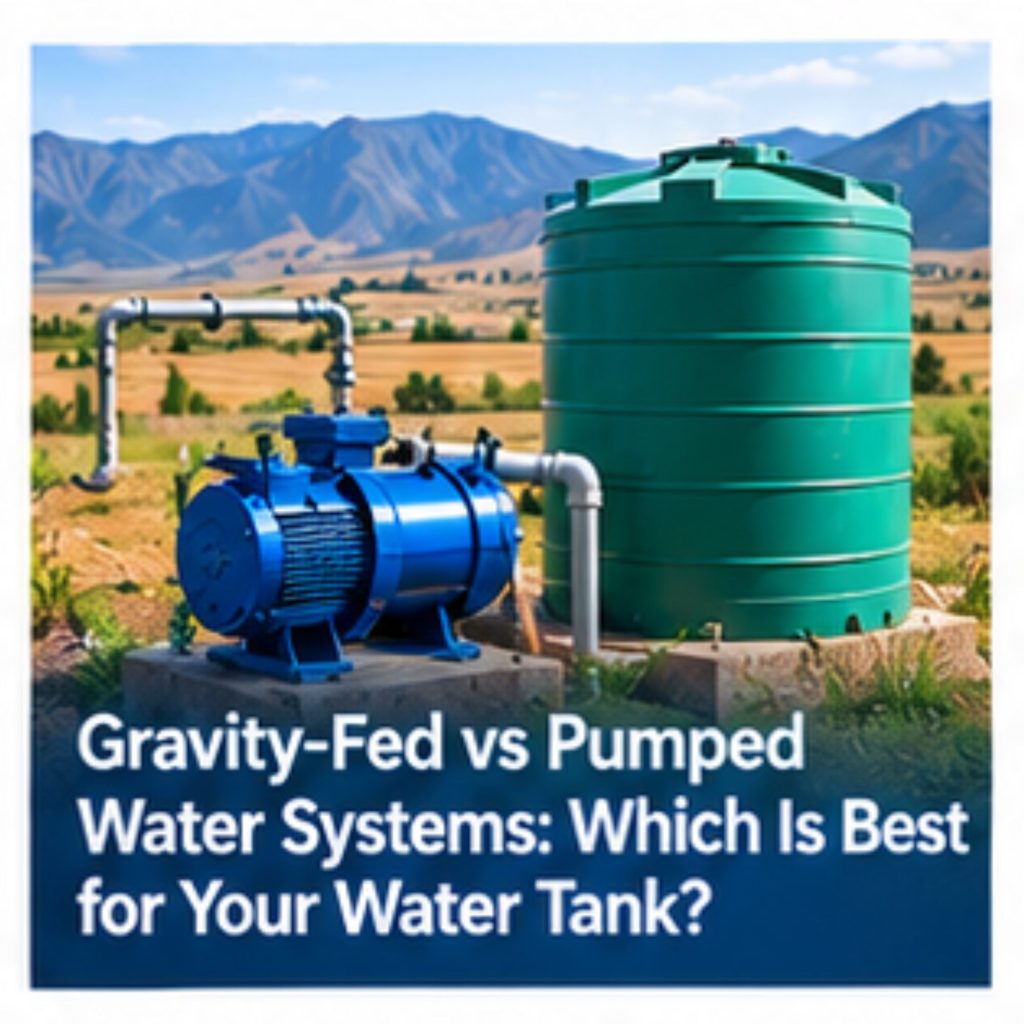
Gravity-Fed vs Pumped Water Systems: Which Is Best for Your Water Tank?
Jul
Gravity-Fed vs Pumped Water Systems | Which Water Tank System Is Right for You?
Should you choose a gravity-fed or pumped water system? Learn the advantages, disadvantages, costs and best applications for each water tank setup.
When installing a water storage tank, one of the biggest decisions you’ll make is how the stored water will reach its destination. Some systems rely entirely on gravity, while others use pumps to provide consistent pressure throughout the property.
Both approaches have advantages, and the best choice depends on your property’s layout, the intended use of the water and the level of pressure required.
In this guide, we’ll compare gravity-fed and pumped water systems to help you choose the right solution for your home, farm or business.
Understanding Gravity-Fed Water Systems
A gravity-fed system uses the natural force of gravity to move water from the storage tank to the point of use.
The higher the water tank is positioned above the outlet, the more pressure is created.
No electrical pump is required for the water to flow, provided there is sufficient elevation.
How Gravity Systems Work
A typical gravity-fed system includes:
- Water storage tank
- Stable support structure (if elevated)
- Outlet pipe
- Isolation valve
- Distribution pipework
As water leaves the tank, gravity provides the energy needed to move it through the plumbing system.
Advantages of Gravity-Fed Systems
Lower Running Costs
Since no pump is required, electricity consumption is minimal or non-existent.
Simple Design
Fewer moving parts generally mean fewer components requiring maintenance.
Reliable During Power Outages
Gravity systems continue operating even when electrical power is unavailable, provided the tank is above the points of use.
Quiet Operation
Without a pump, the system operates silently.
Reduced Maintenance
There are no pump motors, pressure switches or controllers to service or replace.
Limitations of Gravity Systems
Gravity-fed systems also have some practical limitations.
These include:
- Lower water pressure.
- Pressure decreases as the tank empties.
- Elevated support structures may be required.
- Limited suitability for high-pressure household appliances.
- Challenging installation on flat properties.
Understanding Pumped Water Systems
A pumped system uses a water pump to deliver water from the storage tank under pressure.
The pump creates consistent flow regardless of whether the tank is positioned at ground level.
These systems are commonly used in modern homes and commercial buildings.
Components of a Pumped System
A typical installation may include:
- Water storage tank
- Water pump
- Pressure controller or pressure tank
- Isolation valves
- Non-return valve
- Pipework
- Filtration (if required)
Advantages of Pumped Systems
Consistent Water Pressure
A correctly selected pump can provide steady pressure throughout the property.
Greater Flexibility
The tank can usually be installed at ground level without relying on elevation.
Better for Larger Properties
Pumps can supply:
- Multiple bathrooms.
- Irrigation systems.
- Workshops.
- Commercial facilities.
- Agricultural operations.
Compatible with Modern Plumbing
Most household appliances perform best with stable water pressure.
Examples include:
- Washing machines.
- Dishwashers.
- Showers.
- Irrigation controllers.
Limitations of Pumped Systems
Pumped systems also have considerations.
These include:
- Electricity consumption.
- More components requiring maintenance.
- Initial equipment cost.
- Pump noise (depending on installation).
- Reduced operation during power outages unless backup power is available.
Which System Produces Better Water Pressure?
For most residential and commercial applications, pumped systems provide higher and more consistent pressure than gravity-fed systems.
Gravity systems depend entirely on the height difference between the water level in the tank and the outlet.
As a general principle:
- Greater elevation creates more pressure.
- Lower elevation produces less pressure.
Where strong, reliable pressure is required throughout a property, a pump is often the preferred solution.
Which System Is Better for Rainwater Harvesting?
Both options can work well.
Gravity Systems
Suitable for:
- Garden irrigation.
- Livestock watering.
- Small agricultural applications.
- Remote locations without electricity.
Pumped Systems
Suitable for:
- Household plumbing.
- Toilets.
- Showers.
- Washing machines.
- Commercial buildings.
- Irrigation requiring consistent pressure.
Hybrid Systems
Many installations combine both approaches.
For example:
- An elevated tank supplies emergency gravity-fed water during power outages.
- A pump provides higher pressure during normal operation.
Hybrid systems offer flexibility and improved resilience.
Comparing Gravity and Pumped Systems
| Feature | Gravity-Fed | Pumped |
|---|---|---|
| Electricity Required | No | Yes |
| Operating Cost | Very Low | Moderate |
| Water Pressure | Depends on elevation | Consistent |
| Installation Flexibility | Lower | Higher |
| Maintenance | Low | Moderate |
| Works During Power Outages | Yes | Only with backup power |
| Suitable for Modern Plumbing | Limited | Excellent |
| Best for Large Properties | Sometimes | Yes |
Choosing the Right Option
Consider the following questions:
- Do you have reliable electricity?
- How much water pressure do you require?
- Is your property flat or sloped?
- Will the system supply a whole house?
- Will irrigation be included?
- Do you need backup water during power failures?
- Is future expansion likely?
Answering these questions will help determine which approach best suits your needs.
Common Mistakes to Avoid
Avoid these common errors:
- Expecting household pressure from a low-level gravity tank.
- Installing an undersized pump.
- Ignoring electrical requirements.
- Forgetting non-return valves.
- Using pipework that is too small.
- Failing to allow maintenance access around the pump.
Frequently Asked Questions
Can I convert a gravity-fed system to a pumped system later?
Yes. Many gravity-fed installations can be upgraded with a suitably selected pump and associated controls, provided the plumbing layout is compatible.
Can a pump be installed on a ground-level water tank?
Yes. This is one of the most common installation methods for domestic and commercial systems.
Which system costs less to operate?
Gravity-fed systems generally have lower operating costs because they do not require electricity for water delivery.
Which system is better during load shedding or power outages?
A gravity-fed system can continue supplying water without electricity, provided the tank is elevated and the plumbing relies on gravity. Pumped systems typically require backup power if water is needed during outages.
Conclusion
Both gravity-fed and pumped water systems have important roles in modern water storage. Gravity-fed systems offer simplicity, low running costs and reliable operation during power failures, while pumped systems provide the consistent pressure expected in most modern homes and businesses.
The right choice depends on your property’s layout, water demand, available power supply and long-term plans. By matching the system to your specific requirements, you can create a reliable and efficient water storage solution that delivers dependable performance for years to come.
Related Articles
Continue exploring our Water Storage Knowledge Centre:
- How to Choose the Right Water Tank
- Water Tank Installation Guide
- Choosing the Right Water Pump
- Understanding Water Pump Curves
- How to Connect Multiple Water Tanks Together
- Rainwater Harvesting Explained
- Water Tank Accessories Explained
- Pressure Pumps Explained
- Pressure Controllers Explained
- Water Tank Maintenance Guide
Expert Insight
Many modern installations use a hybrid approach, combining the reliability of gravity-fed storage with the convenience of a pressure pump. During normal operation, the pump delivers steady pressure for everyday use, while the elevated or stored water remains available as an emergency supply if electrical power is interrupted. This approach can improve resilience without sacrificing comfort, making it an attractive option for many South African homes and businesses.
