
Borehole Pumps, Water Filtration, Water Pumps, Water Storage, Water Storage Tanks
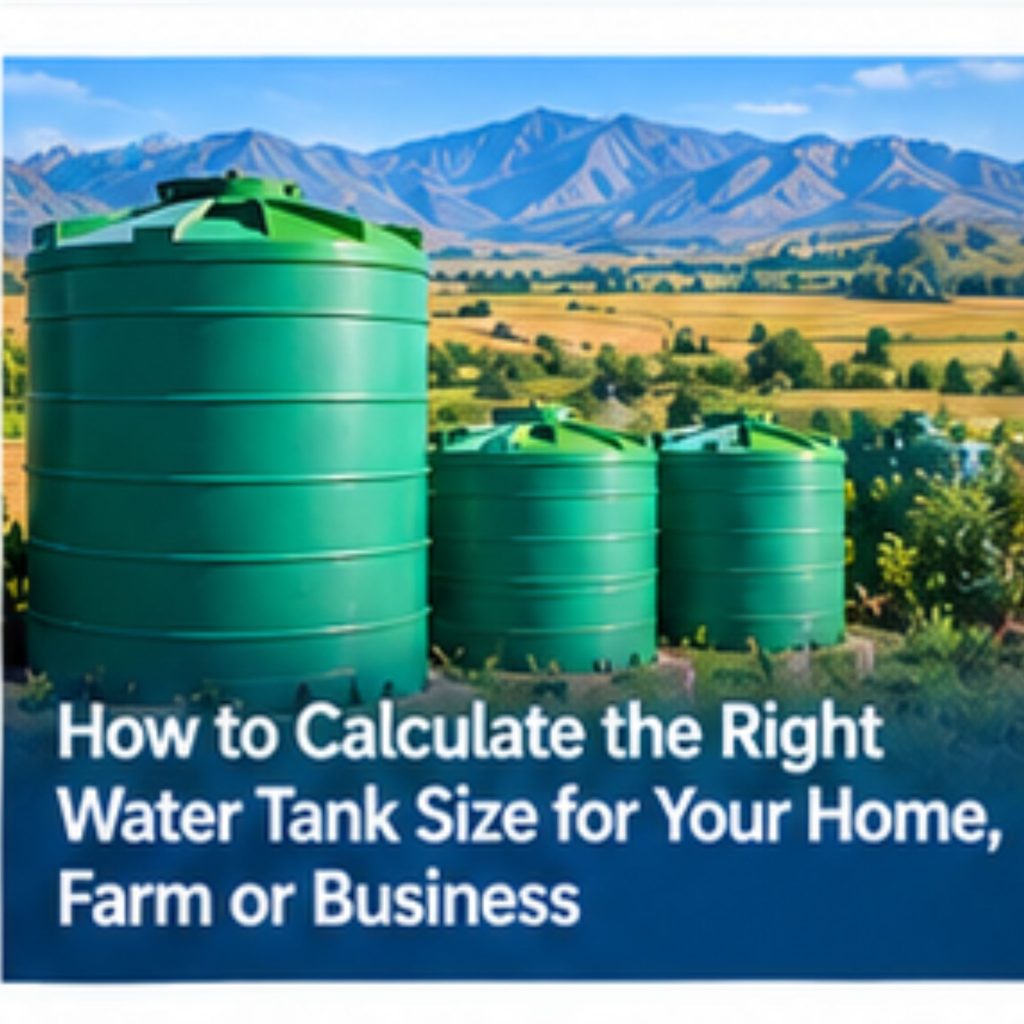
How to Calculate the Right Water Tank Size for Your Home, Farm or Business
Jul
How to Calculate Water Tank Size | Water Storage Calculator & Guide
Meta Description
Not sure what size water tank you need? Learn how to calculate the ideal water storage capacity for your home, farm, business or rainwater harvesting system with our step-by-step guide.
Primary Keywords
- water tank size calculator
- how to calculate water tank size
- what size water tank do I need
- water storage calculator
- water tank capacity guide
Secondary Keywords
- rainwater tank size
- backup water storage
- household water usage
- water tank litres
- tank sizing guide
- water consumption calculator
How to Calculate the Right Water Tank Size
Choosing the correct water tank size is one of the most important decisions you’ll make when investing in a water storage system. A tank that is too small may leave you without enough water during supply interruptions, while one that is much larger than your needs may increase installation costs and require unnecessary space.
The ideal tank size depends on several factors, including how much water you use each day, how long you want your stored water to last, the reliability of your water supply and, if you’re harvesting rainwater, how much rainfall your roof can collect.
This guide explains how to estimate your storage requirements and select a tank that suits your property and budget.
Step 1: Determine How the Water Will Be Used
Before calculating capacity, identify the purpose of the stored water.
Common uses include:
- Municipal backup supply.
- Rainwater harvesting.
- Drinking water (with appropriate treatment).
- Garden irrigation.
- Livestock watering.
- Agricultural irrigation.
- Commercial processes.
- Emergency fire protection.
Different applications require different storage volumes.
Step 2: Estimate Daily Water Usage
The easiest way to size a tank is to estimate how much water is used each day.
Typical household water consumption varies depending on occupancy and lifestyle.
| Household | Approximate Daily Usage |
|---|---|
| 1 person | 150–250 litres |
| 2 people | 300–500 litres |
| 4 people | 600–900 litres |
| 6 people | 900–1,300 litres |
These figures are estimates. Actual consumption depends on water-saving fixtures, gardening, appliance use and personal habits.
Typical Household Water Use
The table below provides an indication of where water is commonly used in the home.
| Activity | Approximate Water Use |
|---|---|
| Toilet flush | 4–9 litres |
| Shower (5 minutes) | 40–60 litres |
| Washing machine | 50–100 litres |
| Dishwasher | 10–20 litres |
| Hand washing dishes | 15–30 litres |
| Garden hose (10 minutes) | 100–180 litres |
Using water-efficient appliances and fixtures can significantly reduce total daily demand.
Step 3: Decide How Many Days of Storage You Need
The next step is determining how long you want your stored water to last.
Examples:
| Backup Period | Suitable For |
|---|---|
| 1–2 days | Short municipal interruptions |
| 3–5 days | Regular outages |
| 7 days | Areas with unreliable supply |
| 14+ days | Farms and remote properties |
Multiply your estimated daily usage by the desired number of backup days.
Example
A family of four uses approximately 700 litres per day.
For five days of backup:
700 × 5 = 3,500 litres
A 5,000-litre tank would provide additional capacity for unexpected demand and future growth.
Step 4: Consider Rainfall (Rainwater Harvesting Systems)
If you’re collecting rainwater, tank size should also take local rainfall into account.
A large roof in a high-rainfall area may justify a larger storage tank, while a smaller roof or low-rainfall region may not be able to refill a very large tank efficiently.
The volume of rainwater that can be collected depends on:
- Roof surface area.
- Rainfall.
- Roof material.
- Collection efficiency.
- First-flush diversion.
Estimating Rainwater Collection
A commonly used estimate is:
Roof Area (m²) × Rainfall (mm) × 0.8 = Litres Collected
The factor of 0.8 allows for typical collection losses due to evaporation, first-flush diversion and minor inefficiencies.
Example
Roof area: 180 m²
Rainfall: 25 mm
Calculation:
180 × 25 × 0.8 = 3,600 litres
This means a single rainfall event of 25 mm could potentially collect approximately 3,600 litres of water under suitable conditions.
Step 5: Consider Available Space
The largest tank isn’t always the best choice.
Measure:
- Width.
- Length.
- Height.
- Delivery access.
- Clearance around the tank.
- Space for future maintenance.
If space is limited, multiple interconnected tanks or slimline tanks may be a better solution.
Step 6: Think About Future Needs
Your water requirements may increase over time.
Consider:
- Family growth.
- Garden expansion.
- Additional buildings.
- Livestock.
- Irrigation systems.
- Business growth.
Installing a system that can be expanded later is often a practical approach.
One Large Tank or Multiple Smaller Tanks?
Both options have advantages.
One Large Tank
Advantages:
- Fewer fittings.
- Simpler plumbing.
- Potentially lower installation complexity.
Considerations:
- Requires more uninterrupted space.
- Delivery and positioning may be more challenging.
Multiple Tanks
Advantages:
- Easier transport and installation.
- Expandable over time.
- Greater flexibility.
- Redundancy if one tank requires maintenance.
Considerations:
- Additional pipework and fittings are required.
Common Sizing Mistakes
Avoid these common errors:
- Choosing the cheapest tank without calculating demand.
- Forgetting irrigation requirements.
- Ignoring seasonal rainfall.
- Not planning for future expansion.
- Underestimating household water use.
- Buying based solely on available space.
Frequently Asked Questions
What size water tank does a family of four need?
The answer depends on daily water consumption and how long you want the stored water to last. Many households choose tanks between 3,000 and 10,000 litres, depending on their backup requirements and available space.
Is it better to oversize a water tank?
A modest safety margin is often beneficial, particularly if your water needs are likely to increase. However, the best size depends on your available space, budget and water supply.
Can I connect two smaller tanks together?
Yes. Interconnecting tanks is a common solution that allows storage capacity to increase as requirements grow.
How do I know if my tank is too small?
If the tank frequently runs empty before the next expected refill—from rainfall, municipal supply or another source—you may benefit from additional storage or improved water management.
Conclusion
Calculating the correct water tank size is about understanding your water needs rather than simply choosing the largest tank available. By estimating daily consumption, deciding how many days of backup you require and considering rainfall, available space and future expansion, you can invest in a storage system that provides reliable performance for years to come.
A well-sized water tank not only improves water security but also helps you make efficient use of your budget and available space.
Related Articles
Continue exploring our Water Storage Knowledge Centre:
- The Complete Guide to Water Storage Tanks
- How to Choose the Right Water Tank
- Water Tank Installation Guide
- Rainwater Harvesting Explained
- Polyethylene Water Tanks Explained
- Slimline vs Vertical Water Tanks
- Water Tank Maintenance Guide
- How to Connect Multiple Water Tanks Together
- Choosing the Right Water Pump for Your Tank
- Water Tank Accessories Explained
